Sunday, February 15, 2015

FAA Small UAS Rules-Info

The following are some of the major discussion points from the FAA's Proposed Small UAS Rules news conference (Sun 15 Feb 2015):

Two primary focus for integration of UAS into the U.S. National Airspace System (NAS)
1) Keeping UAS well clear of other aircraft
2) Mitigating risk

Specific details regarding announcement:
  • Weigh less than 55lbs
  • 100mph airspeed and 500ft above ground level (AGL) altitude limits
  • Unaided visual line of sight (glasses acceptable)
  • Buffer between manned/unmanned aircraft (as authorized by ATC at airport)
  • N/A to recreational
  • Daytime operations
  • New knowledge test based UAS operator certificate (24 mo recurrent testing; broad access to testing centers); fundamentally different than being a private pilot, but do need to understand how to operate in same airspace as manned aircraft; treated as endorsement on current ratings (needed by current pilots) with no separate medical requirement
  • Pre-flight inspection by pilot
  • No airworthiness certificate required
  • Must operate under clear set of parameters to maintain safety
  • Need to determine if a category for micro aircraft is warranted (4.4lbs or less; public comment requested)

Related points/comments:
  • President Barack Obama just released policy (memorandum) regarding military use of UAS (i.e., privacy and protection)
  • More than two dozen 333 exemptions have been approved thus far for commercial operations
  • This rule will accommodate future innovation in the industry
  • Wide variety of activities, especially those that are dangerous, where UAS can provide benefit:
    • Public safety/inspection
    • Academic education and research and development
    • Wildlife conservation/crop monitoring
    • Aerial filming
  • Proposed rule, not a final rule; it is a milestone towards NAS integration; very focused on the large class of potential users
  • FAA continues to support aggressive research into beyond line of sight (BLOS); there will still be other activities (e.g., research) to support the evolving industry and its needs
  • Significant comments expected, but comprehensive framework has been proposed to address comments; feedback will help to determine the best plan to support operation and users, comments are encouraged
  • Operators must continue to apply for approval (including 333 exemption), until this rule finalized
  • Safety is number one priority; working as quickly and safely as possible to achieve integration
  • Compliance will be achieved through education (i.e., public outreach; e.g., Know Before You Fly campaign) and use of enforcement tools to prevent operation in careless and reckless manner (same as manned aviation); rule, as finalized, will provide flexible access and accommodation that ensures highest levels of safety

UPDATE (16 Feb 2015): Check out the following links from sUASNews.com, which provide addition information and insight regarding the FAA announcement and the Presidential memorandum:


This announcement and release of the proposed rules for operation of sUAS represents an exciting step towards achieving full UAS integration into the NAS. The FAA has proposed a method of providing airspace access to a significant number of users, without requiring undue financial burden (est. $300 every 24mo; supports accommodation). This framework is further anticipated to ensure the establishment and maintenance of safety (highest priority), support growing interest in this technology, and encourage innovative use and development of associated capability (i.e., technological advancement). As of late, many stakeholders in this industry had voiced concerns that existing regulatory practices and policies were not conducive to the success and growth of the unmanned systems industry. However, with this recent development, the FAA has demonstrated their willingness to work collaboratively with stakeholders to create a safe, efficient, and effective operating environment that supports the needs of users, including researchers, academics, training specialists, entrepreneurs, recreational hobbyists, first response personnel, and safety advocates.

FAA Small UAS Rules News Conference

There is potentially big news for small UAS operations being released today by the FAA:

The following provide very interesting reads relating to this unfolding scenario, which appears to have be in response to the crash of a DJI Phantom earlier this year on the White House lawn, click the links on the pages to see the full documents:


If these documents turn out to be legitimate, it could be good news indeed (no private pilot certificate, just knowledge based exam; low cost aircraft registration; framework that is similar to CA, UK, and AU). 

I encourage anyone with an interest in small UAS to call in and listen:
 

WHO: Conference Call with U.S. Transportation Secretary Anthony Foxx and FAA Administrator Michael Huerta

The call-in number for the call is (800) 230-1059. The operator will ask you what you're calling in for. Tell the operator you are calling in for the DOT Press Briefing. There will be an opportunity to ask questions at the end. To ask a question press *1.


UPDATE: New phone number for this call: 202 493 4180 passcode 6238#. Delayed briefing until 10:30 a.m.


Thursday, January 29, 2015

ERAU-W Berlin UAS Workshop

I recently had the opportunity to travel to Berlin to lead a two-day workshop covering the important factors affecting the UAS industry. In support of this, I provided some background on why such educational pursuits and collaboration are important to this growing field. You can read about my thoughts on the following article, published on the Embry-Riddle Aeronautical University-Worldwide, Europe website: http://europe.erau.edu/news-events/worldwide-uas-training-comes-to-berlin/index.html

I've also attached some additional photographs from the workshop and trip.


Demonstrating an example of a micro-air vehicle (MAV), a low-cost entry point example of UAS technology


The workshop participants and campus staff

Nighttime view of Berlin


Checkpoint Charlie


Monday, November 3, 2014

ERAU-W 2nd SUAS Competition and Demonstration


This weekend, I had an opportunity to assist with ERAU-Worldwide's second Small UAS Challenge held at the Wings Over Houston airshow at Ellington Field, TX (the first was held recently at the Reno Air Races in September). What a great experience this proved to be! I met many aviation enthusiasts, including the younger generation of remote control model aircraft pilots. 


Using hardware purchased by ERAU (Syma 5Xc and Helimax quadcopters), donated materials, and participation of local operators, we were able to engage and introduce the public to this technology, our education programs, and possible career opportunities. We invited people to try their hand at flying RC aircraft using donated copies of Real Flight 7 RC Flight Simulator (several copies donated by the awesome folks at Hobbico/Great Planes). Some were even able to progress to flying the affordable, yet very capable demonstration quadrotors we brought in our custom enclosure (structure was approved by the FAA for on site, exterior flight operations). Throughout the weekend, we provided flight demonstrations to exhibit the capabilities of these systems (had a few minor crashes without mishap even though steady winds were 10-15 knots, gusting up to 20 knots). 


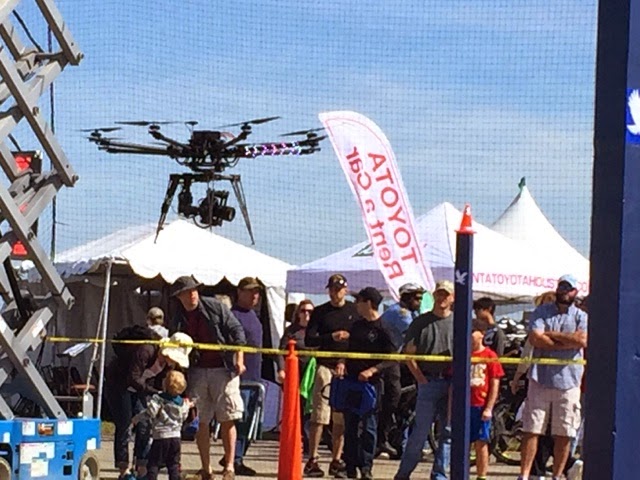
One of our event participants, Droneworks, provided amazing demonstrations showcasing first person view [FPV] operations (output of video feed displayed on a large monitor for public viewing) and flight capabilities of their large octocopter, which they use for professional aerial photography and filming. Another of our competitors demonstrated the stability of the DJI Phantom 2 platform, despite the fairly high winds.  I look forward to more such opportunities to provide public outreach and education regarding the safe, efficient, and effective use of unmanned aircraft technology for both recreation and purposed application. Credit for the success of this event is due to the combined efforts of David Thirtyacre, Jeff Jorgensen, Dr. Timothy Holt, and Scott Burgess, who worked tirelessly to setup and run this competition and demonstration.

Check out some more pictures from this event below.


Tuesday, October 7, 2014

ERAU sUAS Challenge II-Wings Over Houston

Embry-Riddle Aeronautical University is holding a second sUAS Challenge, this time at the Wings Over Houston air show (November 1-2) at Ellington Field, Houston, TX. If you are a R/C quad/multirotor pilot that would like to compete or if you have an interest in this growing field, come on out!
 
OVERVIEW:
Two major issues surrounding the use of sUAS in national airspace system (NAS) are safety and liability.  To mitigate these concerns (i.e., Federal Aviation Administration (FAA) regulations governing the use of UAS are in the development phase), an outdoor facility enclosed with safety netting will be used.  The netted arena will be considered a “structure” by the FAA and all sUAS flights will be limited to, and strictly controlled inside this area.  Additionally, participants are required to sign an acknowledgement of liability.  The race course will be challenging so damage to a participant’s sUAS is possible.
 
PARTICIPANTS:
The Challenge is open to any private, academic or commercial participant (one vehicle per entity) with a maximum field of 20 entries or to be determined by the event staff. The sUAS must be able to take off and land vertically (VTOL); be less than approximately 36 inches in major axis and less than 18 inches in elevation; and weigh less than 10 pounds.  The sUAS will be required to use an electric propulsion, actuation, and power system controlled by remote transmission adhering to FCC regulations in the unlicensed bands (other bands may be used as long as the operator holds at least a Technician Class Amateur Radio license and produce documentation that they are approved to transmit in a given band and power level). To manage control reliability, a spectrum analyzer will be employed to ensure deconfliction.
 
CHALLENGE:
The Challenge will be composed of three separate events that will result in both overall and individual event champions.  The events will be (subject to change):
 
​- Obstacle Course (emphasizing agility and maneuverability, time measured)
​- Dead Lift (lifting ability, weight measured both maximum and specific weight)
​- Time Trial (speed over a closed course, time measured)
 
Initial inspection of each sUAS will occur prior to the competition each morning to ensure compliance with size and modification rules.  A full list of rules will be available upon request.  The Challenge will take place over two days beginning with a mandatory operators meeting at 9:00 a.m. followed by the competition.  The course will be open for practice on Friday prior to the competition. There is no charge for entry in the ERAU sUAS Challenge. This event is being organized by David Thirtyacre, Assistant Professor of Aeronautics (thirtyad@erau.edu).

I will also be in attendance to talk about our UAS related educational programs and give folks an opportunity to fly simulated aeromodels using Real Flight 7 (recently donated by the great folks over at Hobbico/Great Planes) and a couple actual micro quadcopters. To read more about this event, which first ran at the Reno Air Races visit:
http://worldwide.erau.edu/newsroom/press-releases/small-uas-fly-high-during-national-championship-air-races-in-reno.html

http://www.rgj.com/story/life/2014/09/07/reno-air-races-pilots-take-air-week/15153461/

Friday, September 26, 2014

An Unexpected Honor

I like to think that I am fairly well attuned to my work environment and able to provide proactive response through preparedness and situational awareness. However, this week I was caught completely off guard. While attending the 2014 Embry-Riddle Aeronautical University-Worldwide Conference, I was bestowed with the 2013-2014 Faculty Member of the Year award. Considering that I joined the ranks of academia just two short years ago (temporal disassociation, i.e. ability to sense passage of time, does actually occur when one is engaged in enjoyable activity; Agarwal and Karahanna, 2000), this was not an event I had registered as even a remote possibility. 

As this occasion was such an inconceivable surprise, I could not effectively articulate what this truly means to me. I was caught up in the exciting, terrifying, and emotional moment. So now that I have had time to reflect, I would like to put down in words what was swirling through my mind, but was unable to express.

In 2012, my first week as an Assistant Professor was spent at this very same conference meeting all of my new colleagues, while looking ahead down the challenging road before me. During this initiation into ERAU-Worldwide faculty, the gentleman who would later become my Dean gave me invaluable advice and mentorship. Dr. Ken Witcher introduced me to the ever expanding world in which I now find myself. He challenged me to set and strive to meet high goals, while focusing on those critical components of higher education; teaching, research, service, collaboration, communication, and quality. At this first conference, he won this very same award, setting a high standard and expectation.

These last two years, I have taken his and other colleagues advice to heart. We do not do what we do for accolades, acclaim, and awards. We do this for our students. We do this for our comrades. We do this out of love of the work, for the pursuit of ideals, the quest for greater knowledge, and the opportunity to share what we have learned and experienced. This distinction does not belong to me, it belongs to all those I have had the pleasure to work, argue, debate, endeavor, and collaborate with. It belongs to our students, staff, and leadership who all play such an important part of our University. It belongs to my family, my wife, daughter, and son who support me as I explore this amazing and surprising world and try to leave it better than I found it. I thank you all for the support, guidance, and fellowship these last two years and promise to continue to strive together to meet ever greater expectations on this exciting and promising road before us.

Most sincerely,

Brent Andrew Terwilliger, Ph.D.

REFERENCE
Agarwal, R., & Karahanna, E. (2000). Time flies when you're having fun: Cognitive absorption and beliefs about information technology usage. MIS Quarterly, 24(4), 665-694. Retrieved from  http://www.jstor.org/stable/3250951


UPDATE (7 Oct 2014)- The video from this event is available at (look for me around the 0:29:30 mark): http://www.kaltura.com/index.php/extwidget/preview/partner_id/820961/uiconf_id/14627121/entry_id/0_rpcwrv7j/embed/auto?

Tuesday, August 26, 2014

Latest Issue of ERAU's Lift Focused on UAS

Check out the latest issue of Embry-Riddle Aeronautical University's alumni magazine, the Lift, focused on the present and future of UAS. I had a great experience being interviewed by Sara Withrow, the Editor for Lift and one of the authors of the cover story "All around us: Unmanned aircraft systems are the next aviation evolution." This article features commentary from many UAS experts across ERAU (Worldwide, Daytona Beach, and Prescott campuses).

This edition also includes a mention of our new Master of Science in Unmanned Systems (MSUS) degree by ERAU president, Dr. John P. Johnson (inside cover), and a writeup (p. 3) by Molly Justice, the director of communications for ERAU-Worldwide.

You can find this edition of the Lift magazine at: http://www.nxtbook.com/nxtbooks/mcmurry/lift_2014fall/index.php#/0

If you would like to learn more about the new ERAU-Worldwide MSUS degree, please visit: http://worldwide.erau.edu/unmanned