My initial series of ground tests for the small unmanned aerial system (sUAS) research were highly successful.
Stage 1 - Control Servos Response Testing
For this stage, I was able to confirm elimination of the previously observed servo response jitter/stutter and improve timing by switching to the Pololu serial servo protocol. The difference in performance between Pololu and MiniSSC was remarkably different (see the following video):
Stage 2 - Powerplant/Tail Rotor Testing
For this stage, I was able to confirm proper response of the electronic speed control (ESC), brushless motor, gyroscope, and tail rotor. To improve safety, I removed the main blades and left the flybar paddles in place (see the following video):
Stage 3 - Integrated Controls and Powerplant
For this final stage, I was able to confirm successful integration of all the controls and the availability of sufficient power for operation. I connected all controls, applied maximum/minimum control limits (5% for cyclic pitch/roll, 50% for throttle/collective pitch, and 25% for tail rotor), connected power, and interfaced with PC control (i.e., ground control station [GCS]; see the following video):
After wrapping the final video I did achieve a brief airborne hop with a slight adjustment to the collective pitch limit (increased to approximately 60% of available movement, no throttle change was necessary). I am highly confident at this stage that the platform is ready for aerial testing activities and will fly with the increased weight of the custom developed landing gear. However, before I initiate aerial testing I will need to confirm the weight and balance (i.e., center of gravity [CG]) of the sUAS. Check back soon for more updates.
Sunday, February 24, 2013

Friday, February 22, 2013
sUAS Platform Ready for Ground Testing
This week I was able to make considerable gains in improving the resolution of the servo movement. I also put some work into preparing the helicopter for ground testing by wrapping and securing all of the electronics and the associated wiring. I decided to replace the stock landing gear and create my own using carbon fiber gear from a fixed-wing platform and some 1/2" PVC tubing. I expect this new landing gear will help distribute some of the weight during the testing and provide sufficient clearance for the addition of a high-definition first person view (FPV) camera and pan/tilt control assembly in the future.
 |
| sUAS Platform (angled view) |
 |
| sUAS Platform (head-on view) |
 |
| sUAS Platform with cowling removed |
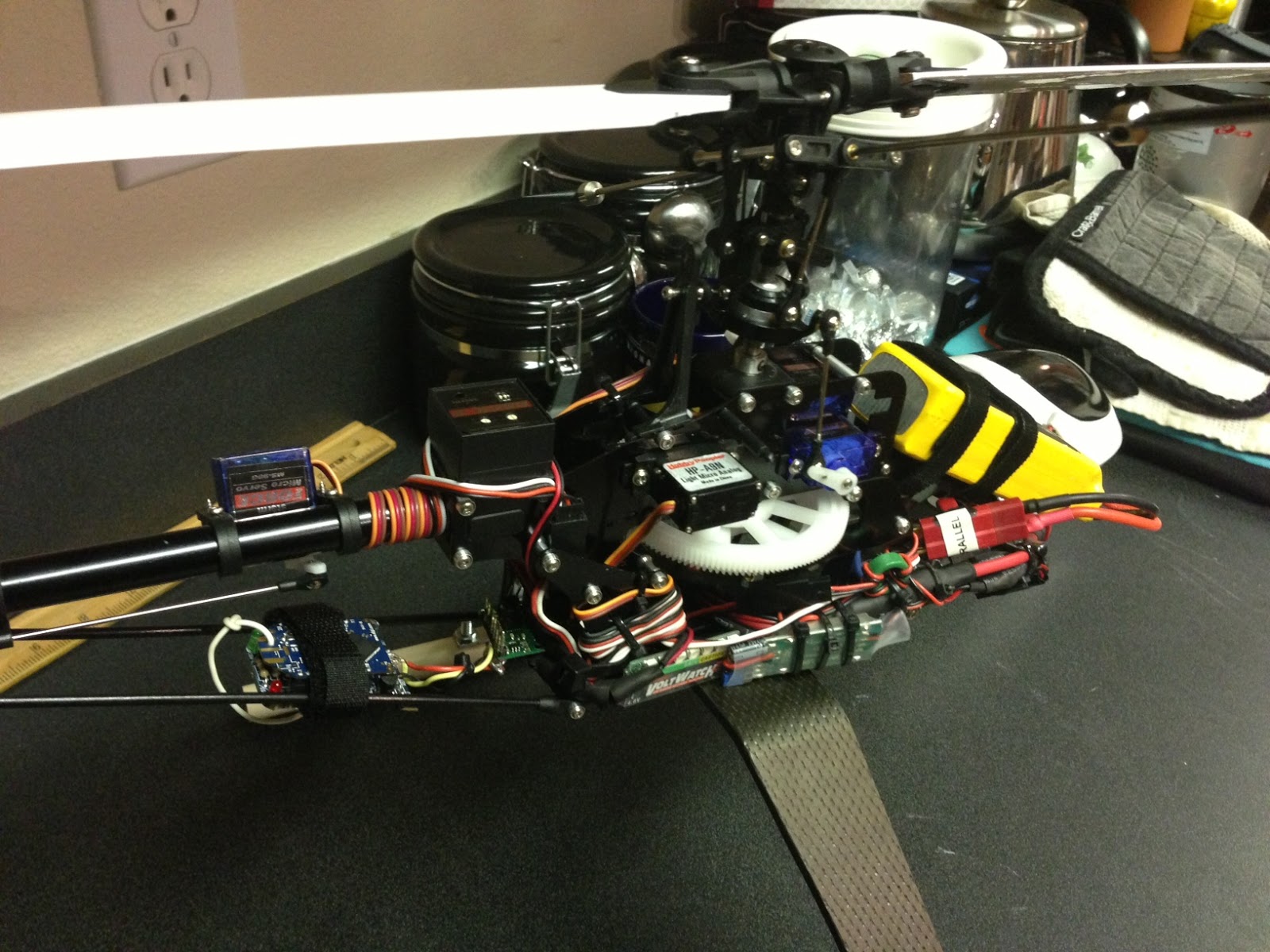 |
| sUAS Platform (electronics exposed) |
Sunday, February 10, 2013
Phase I: Two-Person Supervisory Control of sUAS Research
I am happy to report I have managed to successfully integrate the three 120-degree Cyclic/Collective Pitch Mixing (CCPM) servos of my small unmanned aerial system (sUAS) platform (Storm 430 R/C Electric Helicopter) with my custom developed wireless PC servo control system. This intitial step was a big breakthrough as it proves the software that provides wireless PC, USB gamecontroller, and CCPM servo control does work as required. I still need to fine tune some of the controls and smooth out some slight stuttering, which could lead to adverse operation when in flight. Nonetheless, I was very happy to reach this milestone in development.
The next step in this process will be connect the tail rotor servo and gyroscope for yaw control. Once I have connected the remaining controls (e.g., engine throttle) and fine tuned the movements, I will be ready for an initial flight test. Upon succesful completion of the flight testing I will proceed onto Phases II-VI, as described below:
Phase II
1) Construct supervisory control unit (SCU)
2) Integrate SCU into the sUAS platform to provide primary vehicle control (PVC) and secondary supervisory control (SSC) of the system
3) Confirm capability of SSC system to relinquish control to the PVC and regain as needed (i.e., when SSC controls are engaged)
Phase III
1) Purchase first person view (FPV) visual system
2) Integrate FPV visual system into sUAS platform and base station (i.e., laptop and monitor)
3) Confirm capability to operate the sUAS from an egocentric viewpoint (i.e., video from the sUAS view) using PVC system, with secondary operator providing supervisory control using SSC
Phase IV
1) Purchase onscreen display (OSD) system (see example OSD)
2) Integrate OSD system with FPV subsystem on the sUAS platform
3) Confirm capability to monitor location (GPS coordinates and return to home indicator), altitude, airspeed, and battery voltage using OSD and FPV system
Future Upgrade
At the completion of Phase IV, the sUAS will be fully operational as designed for this research application (proof of concept two-person supervisory control system). With future funding opportunities, I hope to upgrade the sUAS to support additional research with the following:
12 Feb 2013 Update: I've been able to improve the resolution by increasing the communicatio Baud Rate from 9600 to 57600. I've also added in the tail rotor/gyro control. Here is a link to a video update (Updated sUAS Control): http://www.youtube.com/watch?v=c51dKZpmcAk
The next step in this process will be connect the tail rotor servo and gyroscope for yaw control. Once I have connected the remaining controls (e.g., engine throttle) and fine tuned the movements, I will be ready for an initial flight test. Upon succesful completion of the flight testing I will proceed onto Phases II-VI, as described below:
Phase II
1) Construct supervisory control unit (SCU)
2) Integrate SCU into the sUAS platform to provide primary vehicle control (PVC) and secondary supervisory control (SSC) of the system
3) Confirm capability of SSC system to relinquish control to the PVC and regain as needed (i.e., when SSC controls are engaged)
Phase III
1) Purchase first person view (FPV) visual system
2) Integrate FPV visual system into sUAS platform and base station (i.e., laptop and monitor)
3) Confirm capability to operate the sUAS from an egocentric viewpoint (i.e., video from the sUAS view) using PVC system, with secondary operator providing supervisory control using SSC
Phase IV
1) Purchase onscreen display (OSD) system (see example OSD)
2) Integrate OSD system with FPV subsystem on the sUAS platform
3) Confirm capability to monitor location (GPS coordinates and return to home indicator), altitude, airspeed, and battery voltage using OSD and FPV system
Future Upgrade
At the completion of Phase IV, the sUAS will be fully operational as designed for this research application (proof of concept two-person supervisory control system). With future funding opportunities, I hope to upgrade the sUAS to support additional research with the following:
- Nine-degree of freedom (9-DOF) inertial measurement unit (IMU; see example 9-DOF IMU) to measure x, y, and z accelerations, x, y, and z rotations, and x, y, and z magnetic heading readings to provide accurate orientation state (pitch, roll, yaw relative to Earth and magnetic north)
- Range finder sensors for x+, x-, y+, y-, z+, and z- to provide accurate distancing
- Onboard PC for increased injteroperability and calculation capability to support autopilot functionality (i.e., increased autonomy and simplified user control routines; see example single-board PC)
12 Feb 2013 Update: I've been able to improve the resolution by increasing the communicatio Baud Rate from 9600 to 57600. I've also added in the tail rotor/gyro control. Here is a link to a video update (Updated sUAS Control): http://www.youtube.com/watch?v=c51dKZpmcAk
Thursday, January 24, 2013
Use of Personal Experience in APA Writing
Several students
have recently asked about how to best use their personal experience when
addressing areas in their projects or comprehensive exams.
1) Here are some resources to explain citation vs personal experience in APA writing:
Chelsea Lee. (2011, April 28). Can you cite personal life experience? [web log post]. Retrieved from http://blog.apastyle.org/apastyle/2011/04/can-you-cite-personal-life-experience.html
See Locating Appropriate Source Material (Marek, n.d., pp. 3-4):
Marek, P. (n.d.). The basics of scientific writing in APA style. Orange, VA: Worth Publishers. Retrieved from http://www.worthpublishers.com/Catalog/uploadedFiles/Content/Worth/Custom_Solutions/Psychology_ForeWords/Marek_Ch04_APAstyle_Color.pdf
I use "personal experience" and knowledge to establish the general framework of what I'm writing. I then use that framework to define my literature review (research for citable sources), which I use to confirm my statements (i.e., assertions and declarations). Sometimes, I find what I believed to be correct, was not and need to change my statement and line of thinking. Such a situation is exactly why personal experience alone is insufficient, it must be corroborated or supported by others. Despite what we've experienced we are not always correct or the best authority on a subject.
2) The following resources also provide significant APA formatting and writing information:
Purdue Online Writing Lab (OWL; this is a VERY good resource):
Angeli, E., Wagner, J., Lawrick, E., Moore, K., Anderson, M., Soderlund, L., & Brizee, A. (2010, May 5). General format. Retrieved from http://owl.english.purdue.edu/owl/resource/560/01/
APA Style Blog:
American Psychological Association. (n.d.). APA Style Blog. Retrieved from http://blog.apastyle.org/apastyle/
APA Style Homepage
American Psychological Association. (2013). APA Style Homepage. Retrieved from http://www.apastyle.org/
-Brent
1) Here are some resources to explain citation vs personal experience in APA writing:
Chelsea Lee. (2011, April 28). Can you cite personal life experience? [web log post]. Retrieved from http://blog.apastyle.org/apastyle/2011/04/can-you-cite-personal-life-experience.html
See Locating Appropriate Source Material (Marek, n.d., pp. 3-4):
Marek, P. (n.d.). The basics of scientific writing in APA style. Orange, VA: Worth Publishers. Retrieved from http://www.worthpublishers.com/Catalog/uploadedFiles/Content/Worth/Custom_Solutions/Psychology_ForeWords/Marek_Ch04_APAstyle_Color.pdf
I use "personal experience" and knowledge to establish the general framework of what I'm writing. I then use that framework to define my literature review (research for citable sources), which I use to confirm my statements (i.e., assertions and declarations). Sometimes, I find what I believed to be correct, was not and need to change my statement and line of thinking. Such a situation is exactly why personal experience alone is insufficient, it must be corroborated or supported by others. Despite what we've experienced we are not always correct or the best authority on a subject.
2) The following resources also provide significant APA formatting and writing information:
Purdue Online Writing Lab (OWL; this is a VERY good resource):
Angeli, E., Wagner, J., Lawrick, E., Moore, K., Anderson, M., Soderlund, L., & Brizee, A. (2010, May 5). General format. Retrieved from http://owl.english.purdue.edu/owl/resource/560/01/
APA Style Blog:
American Psychological Association. (n.d.). APA Style Blog. Retrieved from http://blog.apastyle.org/apastyle/
APA Style Homepage
American Psychological Association. (2013). APA Style Homepage. Retrieved from http://www.apastyle.org/
-Brent
Tuesday, January 8, 2013
I/ITSEC Paper Available for Download
I've uploaded my paper, Effects of visual interaction methods on simulated unmanned aircraft operator situational awareness, to my blog repository: https://sites.google..com/site/etprepository/repository/12435.pdf
APA 6th ed. citation:
APA 6th ed. citation:
Terwilliger, B. (2012). Effects of visual interaction methods on simulated unmanned aircraft operator situational awareness (paper no. 12435). Proceedings
of the Interservice/ Industry Training, Simulation and Education Conference
2012.
Monday, December 3, 2012
I/ITSEC 2012
I will be at the Interservice/Industry Training, Simulation, and Education Conference (I/ITSEC) this week, where I will be presenting my paper, Effects of Visual Interaction Methods on Simulated Unmanned Aircraft Operator Situational Awareness, on Wednesday at 8:30AM. For more information see the 2012 I/ITSEC agenda: http://www.iitsec.org/attendees/Pages/Agenda.aspx
Saturday, November 17, 2012
USAF Academy- Football Game
On my last night in Colorado Springs I had the opportunity to attend a USAF Academy football game as a VIP. For details and pictures, see my latest entry over at my travel blog: Engineering a Travel Plan....
Subscribe to:
Posts (Atom)